
Have you ever heard of Kilsyth, Tennessee? If you haven’t, you are not alone. This rural, unincorporated community in Campbell County is located just a few miles from present-day LaFollette, tucked away in the Cumberland Mountains. Today, it is easy to pass right by Kilsyth without even realizing it as, to my knowledge, no road sign exists marking its existence and certainly no traffic signals.
Historically, Kilsyth was in a region heavily intertwined with the coal mining industry. Of course, this coal had to be moved, and the Louisville and Nashville Railroad (L&N) was integral to that process. The L&N was chartered in Louisville, Kentucky, on 5 March 1850 to complete a rail line southward, ending at the Tennessee state line. [1] In December 1851, the Tennessee Legislature authorized the railroad to extend its line into Nashville. From that point forward, the L&N expanded its reach by laying new track and absorbing smaller railroads. [2] By 1902, the L&N was a formidable transportation company in the southern United States, but desired to extend its control southward via a line stretching from Cincinnati, Ohio, to Atlanta, Georgia, passing through the coalfields of Tennessee and Kentucky.
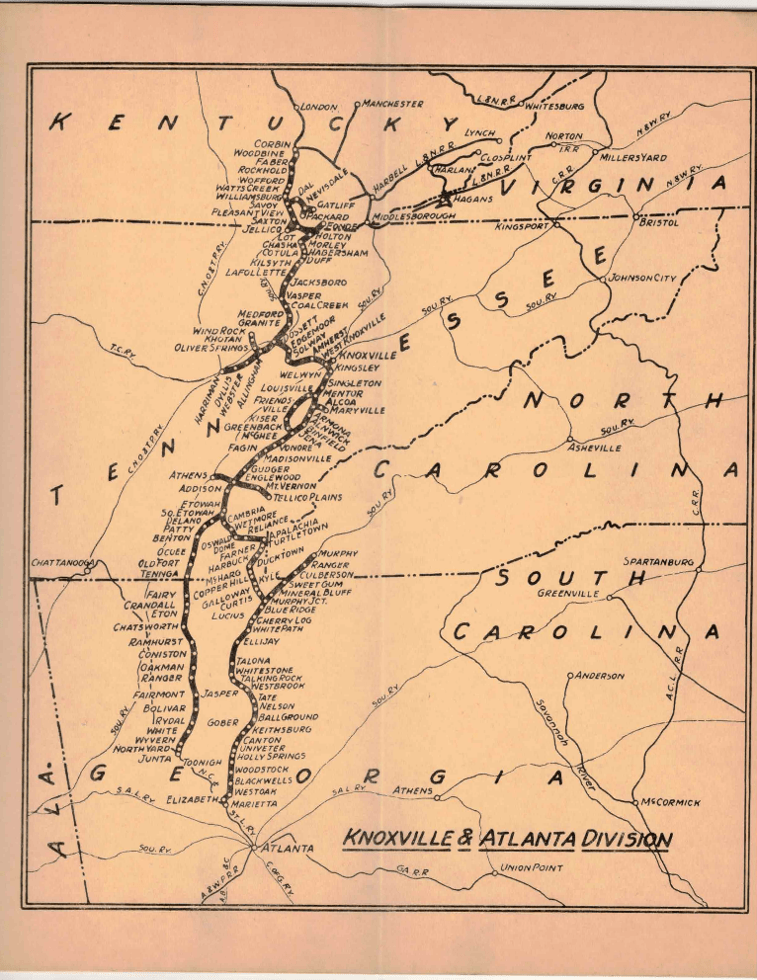
However, tackling the mountains that provided this lucrative coal was no easy task for the railroad. The section of rail between Highcliff, just south of Jellico near the Kentucky border, and LaFollette required the construction of numerous trestles, tunnels, and cuts through difficult and rocky terrain. In fact, many refer to this area as “the Rockies of Tennessee.” The line reached the summit of Duff Mountain near Duff, where it then descended the 1.15% grade southward toward LaFollette, passing through Kilsyth.
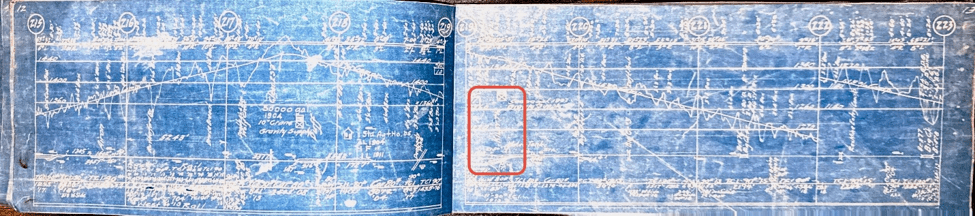
In my personal archives, I have this condensed L&N track profile dated September 1913 of the Knoxville Division (the Knoxville and Atlanta Divisions were consolidated into the Knoxville & Atlanta Division by 1931). The location of Kilsyth is indicated by the red box between mile post 219 and 220. These numbers represent the distance, in miles, by rail from that point to the headquarters of the L&N in Louisville, Kentucky. For instance, Kilsyth is roughly 220 miles from Louisville by train.
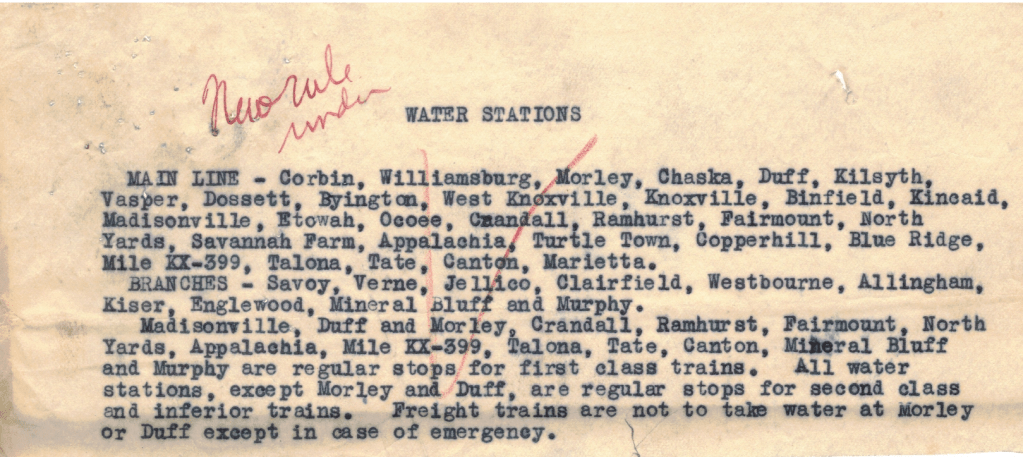
It may be difficult to distinguish on this old track profile, but a water station is indicated at Kilsyth in 1913. Another source I have, which lists the water stations along the L&N Knoxville & Atlanta Division (K&A), also points to the existence of a water station at Kilsyth.
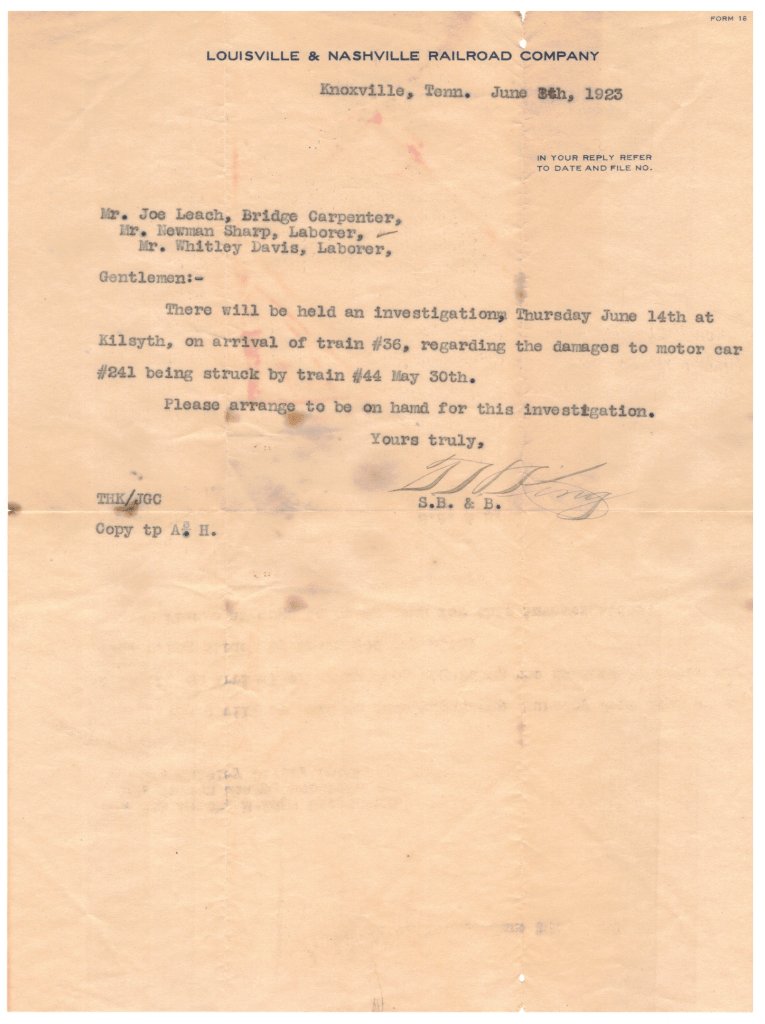
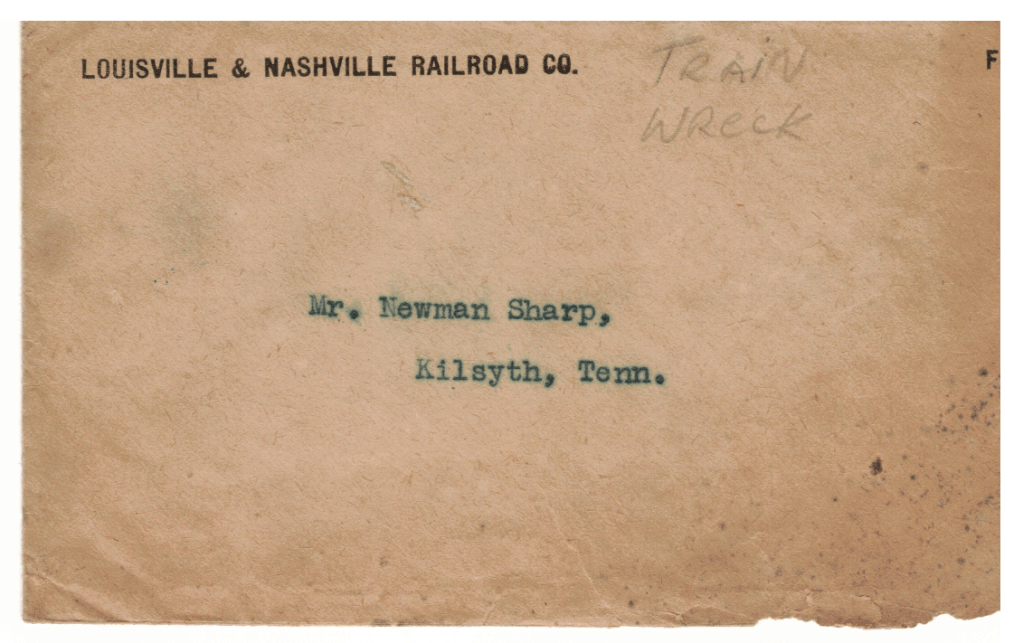
In reality, the whole reason behind writing this post was to highlight this interesting correspondence I recently located referencing Kilsyth. Dated June 1923, and sent from Knoxville by the Louisville & Nashville Railroad, the letter summoned three local railroad employees – Joe Leach, a bridge carpenter, along with laborers Newman Sharp and Whitley Davis – to attend an investigation concerning a collision between Train No. 44, a second class Florida fast freight according to a later 1938 K&A employee timetable, and motor car No. 241 on May 30. Motor cars were small gasoline-powered vehicles used by section and bridge crews to travel the railroad for inspection and maintenance work. Although I could not locate additional resources or references to this particular accident, and the letter does not reveal the outcome of the investigation, it still provides a rare surviving connection to the men who maintained the railroad and to the operational culture of the L&N during the height of the coal industry’s influence in the region.
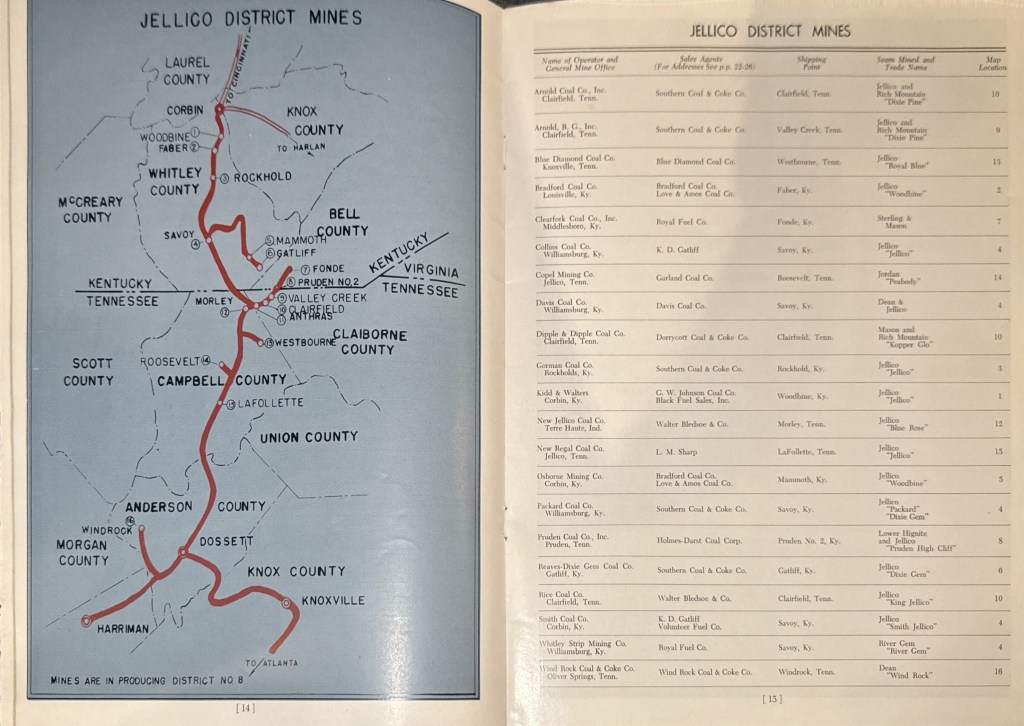
This scan of the Jellico (mining) District shows the approximate location and number of surviving coal mines still served by the L&N in 1958.
I hope you have enjoyed learning a bit about Kilsyth and how a small community in the Tennessee coalfields played a role in the daily operations of the Louisville & Nashville Railroad during the height of the coal era. Sometimes, all it takes is a single surviving letter to reconnect us with the people, places, and events that once shaped everyday life in Appalachia.
Best,
Craig
Bibliography:
[1] Legislative History of the Louisville and Nashville Railroad R.R. Co., 1881, Robert Edward Barclay Collection, Tennessee State Library and Archives, Nashville, TN.
[2] Ibid.
 The Appalachian Record
Leave a comment